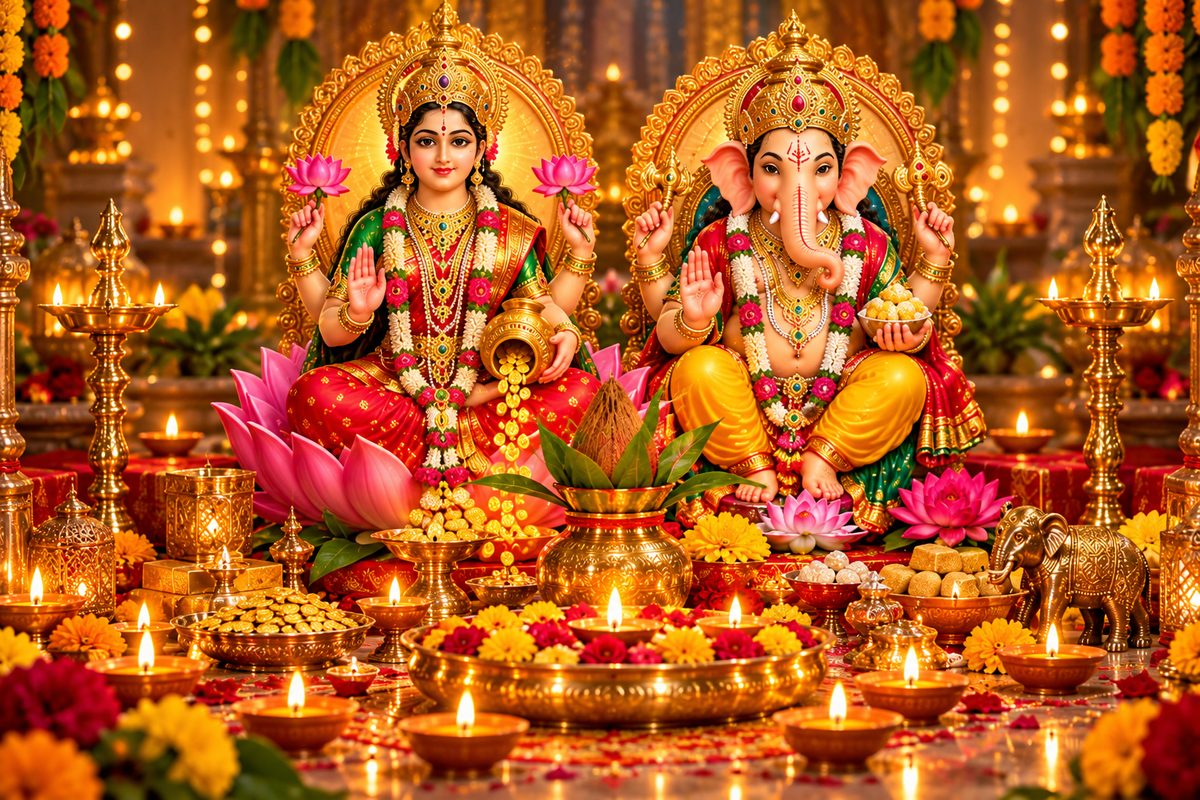
Diwali, also known as Deepavali, is among the most widely observed festivals in India and across the Indian diaspora. Celebrated as the festival of lights, it symbolises the triumph of light over darkness, knowledge over ignorance and good over evil. Homes are cleaned and lit with diyas, rangoli and flowers, and families worship Goddess Lakshmi and Lord Ganesha for prosperity, wisdom and well-being.
This guide covers the date and muhurat for Diwali 2026, the puja samagri, a step-by-step vidhi, key mantras, the aarti, the significance of the festival and safety guidance.
Diwali 2026 Date and Lakshmi Puja Muhurat
Diwali and Lakshmi Puja will be observed on Sunday, 8 November 2026, on the night of Kartik Amavasya. Lakshmi Puja is performed in the evening during Pradosh Kaal, the period after sunset. Many traditions regard the overlap of Pradosh Kaal with a sthir lagna (fixed ascendant) such as Vrishabha as especially auspicious.
- Diwali / Lakshmi Puja: Sunday, 8 November 2026
- Amavasya Tithi (approximate, IST): about 11:30 AM on 8 November to about 12:30 PM on 9 November
- Lakshmi Puja Muhurat: during Pradosh Kaal after sunset; for example, about 5:32 PM to 7:28 PM in Delhi (IST)
Published Panchang calculations differ on the exact window. For example, one lists 5:32 PM to 7:28 PM and another 6:29 PM to 8:29 PM. Timings also vary by city, so confirm the precise muhurat with a trusted local Panchang or your family priest.
Diwali is a five-day festival. It begins with Dhanteras on 6 November (see our Dhanteras 2026 guide), followed by Naraka Chaturdashi (Choti Diwali) on 7 or 8 November depending on the Panchang, Diwali and Lakshmi Puja on Sunday, 8 November, Govardhan Puja on Tuesday, 10 November, and Bhai Dooj on Wednesday, 11 November 2026.
Lakshmi Puja Samagri
- Idols or pictures of Goddess Lakshmi and Lord Ganesha (and Lord Kubera, if your family worships him)
- A raised chowki and a clean red or yellow cloth
- A kalash of clean water with mango leaves and a coconut
- Diyas, cotton wicks, ghee or oil
- Incense, dhoop, camphor, a bell and an aarti plate
- Flowers and garlands (lotus is traditionally preferred for Lakshmi)
- Kumkum, turmeric, akshat and sandalwood paste
- Fruits, sweets and other offerings (naivedya)
- Coins, currency notes, and account books or tools of work
- Rangoli materials for the entrance
The list may be adapted to family and regional customs. Sincerity matters more than elaborate arrangements.
Lakshmi Puja Vidhi: Step-by-Step Rituals
1. Prepare the Home
Clean the house, decorate the entrance with rangoli and torans, and place diyas at doors, windows and balconies. Complete all preparations before the muhurat begins.
2. Set Up the Altar
Spread a clean cloth on the chowki and place the idols or pictures, with Lakshmi to the right of Ganesha. Arrange the kalash, flowers, fruits and sweets in front of them.
3. Take the Sankalp
Light a diya and incense, sit facing east or north, and state your intention to perform the puja with devotion for the well-being of your family.
4. Worship Lord Ganesha First
Ganesha is invoked at the start of any ritual to remove obstacles. Offer flowers, akshat, kumkum and sweets while chanting his mantra.
5. Establish and Worship the Kalash
The kalash represents divine presence and auspiciousness. Offer flowers and akshat to it.
6. Worship Goddess Lakshmi
Invoke the goddess, then offer water, flowers, kumkum, turmeric, fruits and sweets. Chant her mantras with gratitude and focus, praying for prosperity, peace and the responsible use of wealth.
7. Worship Lord Kubera (Optional)
Many families pray to Kubera, the guardian of wealth, for financial stability and sound judgement.
8. Worship Account Books and Valuables
Business families perform Chopda Puja (also called Bahi-Khata Puja) on their ledgers and tools of work, praying for honesty and progress in the year ahead.
9. Perform the Aarti
Wave a lit diya or camphor before the deities while singing the aarti of Lakshmi and Ganesha. Distribute prasad afterwards.
10. Light Diyas and Share the Joy
Place lamps around the home, share sweets with family and neighbours, and consider acts of charity.
Important Mantras for Lakshmi Puja
1. Lord Ganesha Mantra
ॐ गं गणपतये नमः।
Transliteration: Om Gam Ganapataye Namah.
Meaning: Salutations to Lord Ganesha; a prayer for wisdom, success and the removal of obstacles.
2. Goddess Lakshmi Mantra
ॐ श्रीं महालक्ष्म्यै नमः।
Transliteration: Om Shreem Mahalakshmyai Namah.
Meaning: Salutations to Goddess Mahalakshmi, the divine embodiment of prosperity and abundance. Read more on our Lakshmi Mantra page.
3. Shreem Beej Mantra
ॐ श्रीं नमः।
Transliteration: Om Shreem Namah.
A short seed (beej) mantra associated with Goddess Lakshmi, often chanted during meditation and prayer.
4. Lord Kubera Mantra
ॐ यक्षाय कुबेराय वैश्रवणाय धनधान्याधिपतये धनधान्यसमृद्धिं मे देहि दापय स्वाहा॥
Transliteration: Om Yakshaya Kuberaya Vaishravanaya Dhanadhanyadhipataye Dhanadhanya-Samriddhim Me Dehi Dapaya Swaha.
Meaning: A prayer to Lord Kubera for prosperity, abundance and the resources needed to sustain life.
Mantras are traditionally chanted calmly, with careful pronunciation, often in multiples of 11 or 108. Follow your family tradition or priest for the preferred form.
Diwali Aarti
Aarti closes the puja. Families traditionally sing the aarti of Goddess Lakshmi and Lord Ganesha while moving a lit diya in a clockwise circle before the deities, then offer prayers and distribute prasad.
- Lakshmi Mata Aarti: Recite the traditional Om Jai Lakshmi Mata aarti to worship Goddess Lakshmi.
- Ganesh Aarti: Recite Jai Ganesh Deva to seek Lord Ganesha’s blessings.
Why Is Lakshmi Puja Performed on Diwali?
Goddess Lakshmi is revered as the goddess of wealth, fortune and prosperity, and her worship on the new-moon night of Kartik expresses the hope of abundance, harmony and well-being in the household. Lord Ganesha is worshipped alongside her because wisdom and sound judgement are essential to using wealth responsibly. Prosperity here is understood broadly, to include health, knowledge, kindness and family harmony.
For many families, Diwali is also a time to settle old accounts, begin new financial records, reconcile with loved ones and welcome the year ahead with good intentions.
Significance of Diwali
Return of Lord Rama: Tradition associates Diwali with the return of Rama, Sita and Lakshmana to Ayodhya after the defeat of Ravana, when the people welcomed them with rows of lamps.
Worship of Goddess Lakshmi: In much of north, west and central India, Diwali night is dedicated to Lakshmi.
Kali Puja: In Bengal, Odisha and Assam, the same night is observed as Kali Puja.
Other traditions: Jains observe Diwali in remembrance of Lord Mahavira’s nirvana, and Sikhs celebrate Bandi Chhor Divas.
Light over darkness: The lamps symbolise hope, knowledge and goodness overcoming ignorance.
New beginnings: Many households and businesses treat the festival as a fresh start, exchanging gifts, visiting relatives and making plans for the coming year.
Diwali Safety Tips
- Place diyas on stable, heat-resistant surfaces, away from curtains, paper and other flammable materials.
- Never leave burning diyas or candles unattended.
- Keep children and pets away from open flames and firecrackers.
- Wear fitted cotton clothing when lighting lamps; avoid loose synthetic fabrics.
- Follow local rules on fireworks, and consider low-noise, low-smoke celebrations.
- Keep water or a fire extinguisher nearby and know your local emergency number.
Frequently Asked Questions
1. When is Diwali in 2026?
Diwali and Lakshmi Puja fall on Sunday, 8 November 2026.
2. What is the Lakshmi Puja muhurat for Diwali 2026?
It falls in the evening Pradosh Kaal after sunset; for example, about 5:32 PM to 7:28 PM in Delhi (IST). The window shifts with each city’s sunset, so confirm it with your local Panchang.
3. Which deities are worshipped on Diwali?
Goddess Lakshmi and Lord Ganesha are the principal deities. Many families also worship Lord Kubera, and some worship Goddess Saraswati or Kali according to regional custom.
4. Which mantra should be chanted during Lakshmi Puja?
“Om Shreem Mahalakshmyai Namah” is widely used for Lakshmi, and “Om Gam Ganapataye Namah” for Ganesha.
5. What should be offered to Goddess Lakshmi?
Flowers (especially lotus), fruits, sweets, kumkum, akshat and a lit diya, according to family custom.
6. Is Lakshmi Puja performed before or after sunset?
After sunset, during Pradosh Kaal, while Amavasya is in effect.
Continue Your Devotion
- Lakshmi Mantra – Meaning and Lyrics
- Jai Ganesh Deva Aarti
- Ganesha Mantra
- Dhanteras 2026: Puja Vidhi and Vrat Katha
Conclusion
Diwali brings together devotion, family and renewal. Prepare your puja items in advance, confirm the muhurat for your city, chant the mantras with sincerity and conclude with the family aarti. May this Diwali bring peace, wisdom, good health and prosperity to every home.
Shubh Deepavali 2026!